Chair decision · Fit
Check Whether a Chair Can Fit Your Body
Your measurements become useful only when they are compared with the exact chair configuration’s usable dimensions and adjustment ranges. The goal is not to calculate a perfect chair. It is to find out whether a workable setup appears possible, whether a condition such as a footrest is required, or whether evidence is still missing.
This stage checks body-to-chair compatibility. The next workstation stage checks whether the same chair can also work with your desk.
Quick Answer
Use five inputs from the measurement stage: popliteal height, buttock-to-popliteal length, seated hip breadth, seated elbow height and body weight. Compare them with the exact chair’s seat-height range, effective seat depth, usable seat width, armrest range, back/lumbar adjustment and verified whole-chair user-mass rating. If a mandatory value is missing or belongs to another variant, the fit result is UNKNOWN—not PASS.
Chair Fit Anatomy
These visual checks show the six zones we verify before calling an exact chair configuration compatible. The images are explanatory; the decision still depends on your measurements and the exact product evidence.
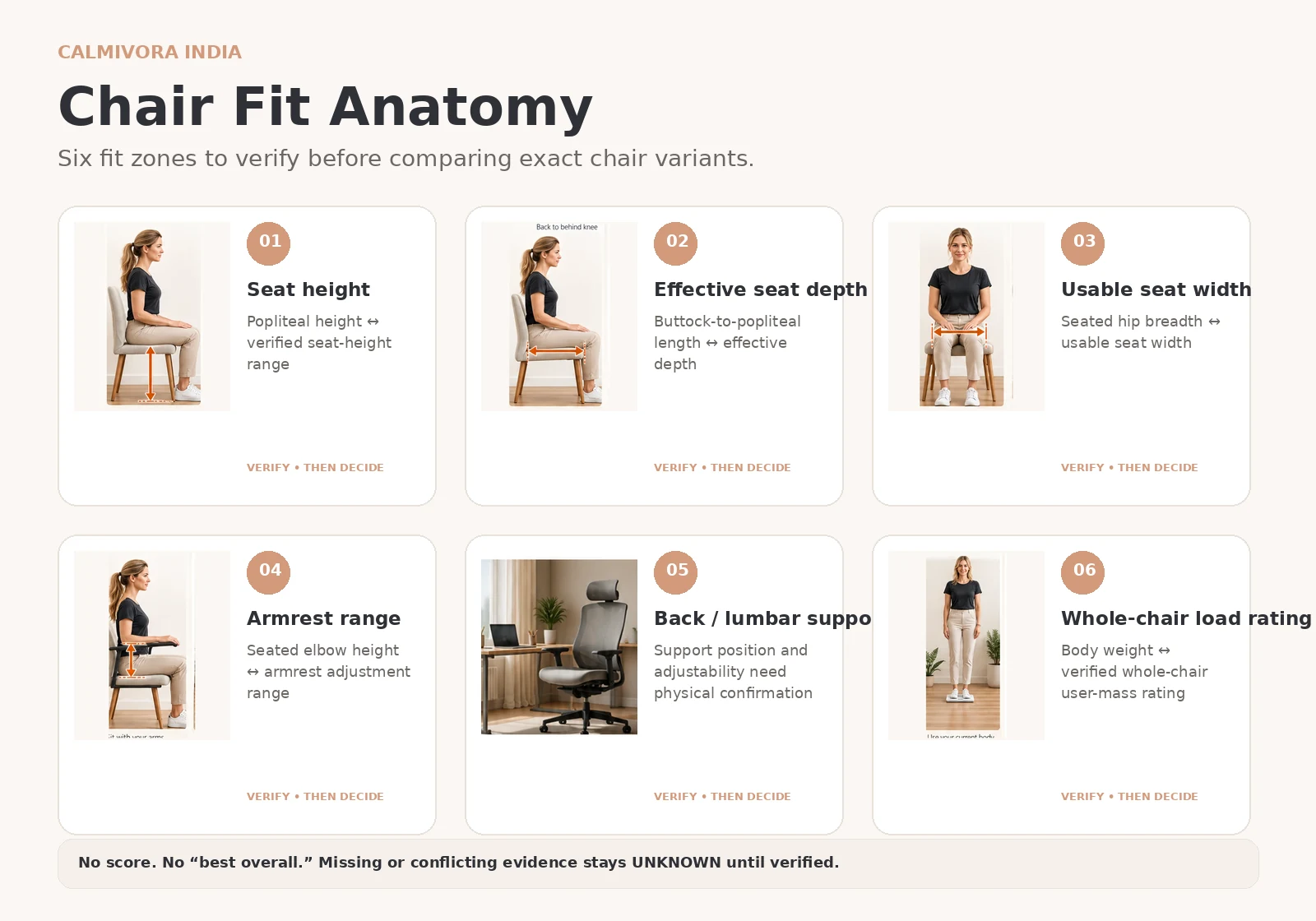
Six fit checks that matter
Each check answers a practical compatibility question. A feature name by itself is not enough.
Input: Popliteal height
1. Can the seat height reach a usable position?
Compare your lower-leg measurement with the chair’s verified seat-height adjustment range, then confirm that your feet can be supported and the setting does not force an impractical desk relationship.
- PASS: a workable setting exists with supported feet.
- CONDITION: the chair may work only with a suitable footrest or a different workstation setup.
- UNKNOWN: the exact seat-height range is not verified.
- FAIL: the verified range cannot provide a workable supported position for this use case.
Do not set chair seat height equal to popliteal height by formula. Footwear, seat compression, foot support and the desk still matter.
Input: Buttock-to-popliteal length
2. Is the effective seat depth compatible?
The chair should support most of the thigh while allowing you to sit fully back and use the backrest without the front edge pressing into the area behind the knee.
- Use effective seat depth, not overall chair depth.
- If a seat slider exists, use its verified usable range.
- A nominal depth without a usable range provides weaker fit evidence.
- Physical sitting remains the final confirmation where possible.
Input: Seated hip breadth
3. Is the usable seat width adequate?
Compare seated hip breadth with the chair’s usable internal seat width. The seat should accommodate the user without restricting normal movement or forcing contact with the sides or arm supports.
- Do not substitute overall chair width.
- Do not substitute external arm-to-arm width.
- If the manufacturer does not publish a usable seat width, mark the criterion unresolved until it can be verified.
Input: Seated elbow height
4. Can the armrests support relaxed shoulders?
Check whether the armrest height range can meet the user’s relaxed elbow position and whether the armrests still allow the chair to approach the desk.
- “4D” is not automatically better than “2D.”
- The actual adjustment range matters more than the direction count.
- Armrests that fit the elbow but collide with the desk may still fail the workstation stage.
Input: Seated back position
5. Can the back and lumbar support meet the user?
Presence of lumbar support is only a feature claim. Fit depends on whether the support contacts the user appropriately when sitting fully back and whether any height/depth adjustment has enough usable range.
- Fixed lumbar: feature present, fit still needs physical confirmation.
- Adjustable lumbar: verify the direction and range when available.
- Do not infer fit from terms such as “orthopaedic” or “ergonomic.”
Input: Body weight
6. Is the whole-chair user-mass rating verified?
Compare body weight only with a verified maximum user-mass rating for the exact chair configuration.
- A gas-lift test capacity is not a whole-chair rating.
- A base or mechanism test is not a whole-chair rating.
- A value from another variant cannot be inherited automatically.
- Calmivora does not invent a safety-margin percentage unless an applicable source justifies one.
How to interpret a fit result
Each criterion receives a state before any product comparison happens.
Compatibility demonstrated
The verified chair range or specification can accommodate the defined requirement.
Works only under a stated condition
For example, a suitable footrest, a specific variant or a physical trial may still be required.
Evidence is missing or conflicted
The correct action is to verify the fact—not to assume the chair probably fits.
Verified incompatibility
The documented range cannot meet the requirement for this user or use case.
A body-fit PASS is not yet a complete chair decision
A chair can fit the person and still be wrong for the desk. Armrests may collide with the work surface, the desk may be too high or too low, knee clearance may be inadequate, or the required seat setting may create poor keyboard alignment.
That is why Calmivora keeps FIT and WORKSTATION as separate gates.
What still needs physical confirmation?
Specifications can eliminate obviously incompatible options, but they cannot describe every interaction between a person and a chair. Where possible, physically verify:
- You can sit fully back and still place the feet securely.
- The seat edge does not press into the area behind the knee.
- The seat feels wide enough to move naturally rather than merely fitting on paper.
- The lumbar/back support contacts the intended area without forcing posture.
- The armrests support the forearms without lifting the shoulders.
- The chair feels stable through normal upright work and movement.
A useful return/trial policy becomes especially valuable when a required fit characteristic cannot be established confidently from published dimensions alone.
Fit worksheet
Record the chair evidence beside your measurements
Use this as a decision record. Do not fill a product field from a marketplace title unless the exact variant and specification are verified.
| Criterion | Your input | Exact chair evidence | State |
|---|---|---|---|
| Seat height | Popliteal: _____ cm | _____ to _____ cm | PASS / CONDITION / UNKNOWN / FAIL |
| Seat depth | BPL: _____ cm | Effective depth: _____ cm / range | PASS / CONDITION / UNKNOWN / FAIL |
| Seat width | Hip breadth: _____ cm | Usable width: _____ cm | PASS / CONDITION / UNKNOWN / FAIL |
| Armrests | Elbow height: _____ cm | Range: _____ to _____ cm | PASS / CONDITION / UNKNOWN / FAIL |
| Back/lumbar | Physical fit check | Adjustment/range: __________ | PASS / CONDITION / UNKNOWN / FAIL |
| User mass | Weight: _____ kg | Whole-chair rating: _____ kg | PASS / CONDITION / UNKNOWN / FAIL |
Common fit mistakes to avoid
- Using standing height as the main selector: it does not reveal the lower-leg, thigh, hip or seated-elbow proportions that affect fit.
- Choosing the deepest seat: more depth is not better when it prevents the user from sitting against the backrest.
- Choosing the widest chair: overall size does not prove usable seat width or useful armrest spacing.
- Buying for “4D arms” alone: direction count does not prove that the range reaches the user or clears the desk.
- Trusting “heavy duty” wording: use a documented whole-chair maximum user-mass rating.
- Treating a product-family specification as exact: variant changes can alter seat slider, mechanism, arms, base and dimensions.
Sources & Methodology
This page converts workstation-fit guidance into Calmivora’s evidence-gated chair-fit method. It is decision support, not medical advice and not a substitute for physical evaluation where symptoms or disability require professional assessment.
- U.S. Occupational Safety and Health Administration — Computer Workstations eTool. Used for seat-height, seat-depth, width, backrest, armrest and workstation-fit principles. Source.
- Canadian Centre for Occupational Health and Safety — How to Adjust Office Chairs. Used to cross-check foot support, elbow/work-surface relationships and the need to evaluate chair, work surface and floor together. Source.
Last reviewed: September 2026. Product-specific conclusions require current evidence for the exact configuration.
Product boundary: This page contains no chair recommendation or affiliate link. It explains how Calmivora decides whether an exact chair configuration can reasonably fit a defined user before product comparison begins.